Episode
Posted 5 may 2026

The Word God Was Too Small To Describe What He Saw

In 1954, the year he began floating naked in a lightless saltwater tank at the National Institute of Mental Health, John C. Lilly expected the isolated brain to go quiet. It did the opposite.

Posted 5 may 2026
Watch on YouTube

The room before the water

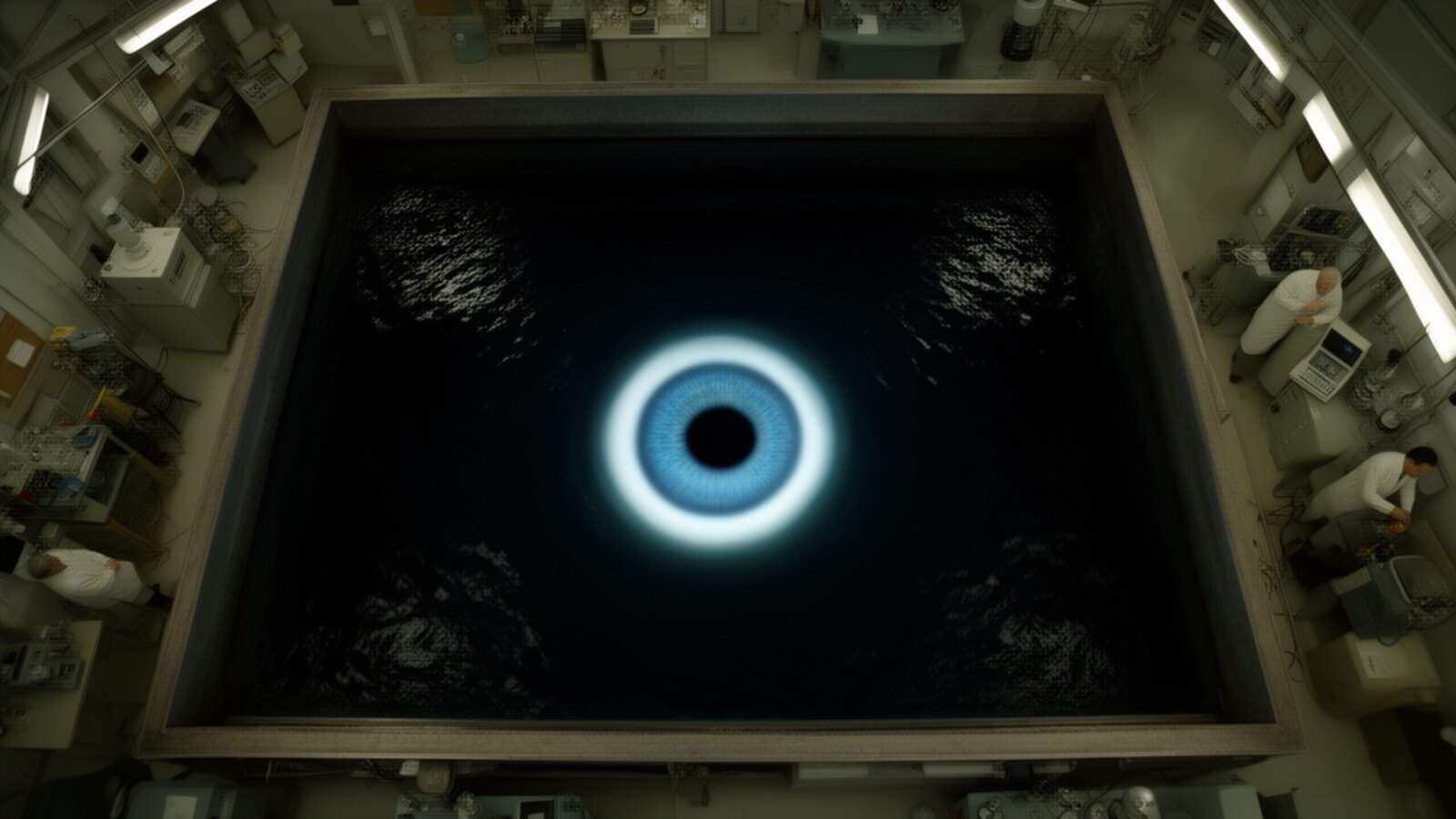
Picture a basement at the National Institute of Mental Health in 1954. Concrete walls hold the cold. A sealed metal door faces the corridor. Warm salt and rubber thicken the air. Oscilloscopes hum on a steel cart, and a clipboard hangs by the entrance on a brass hook. John C. Lilly stands at the threshold at thirty-nine, a physician with a Penn medical degree and years of neurophysiology behind him. He has mapped electrical activity in the cerebral cortex of the macaque. He has pushed microelectrodes into living tissue and watched the ink trace climb across graph paper. Training built him to distrust his own perception before he trusts an instrument.

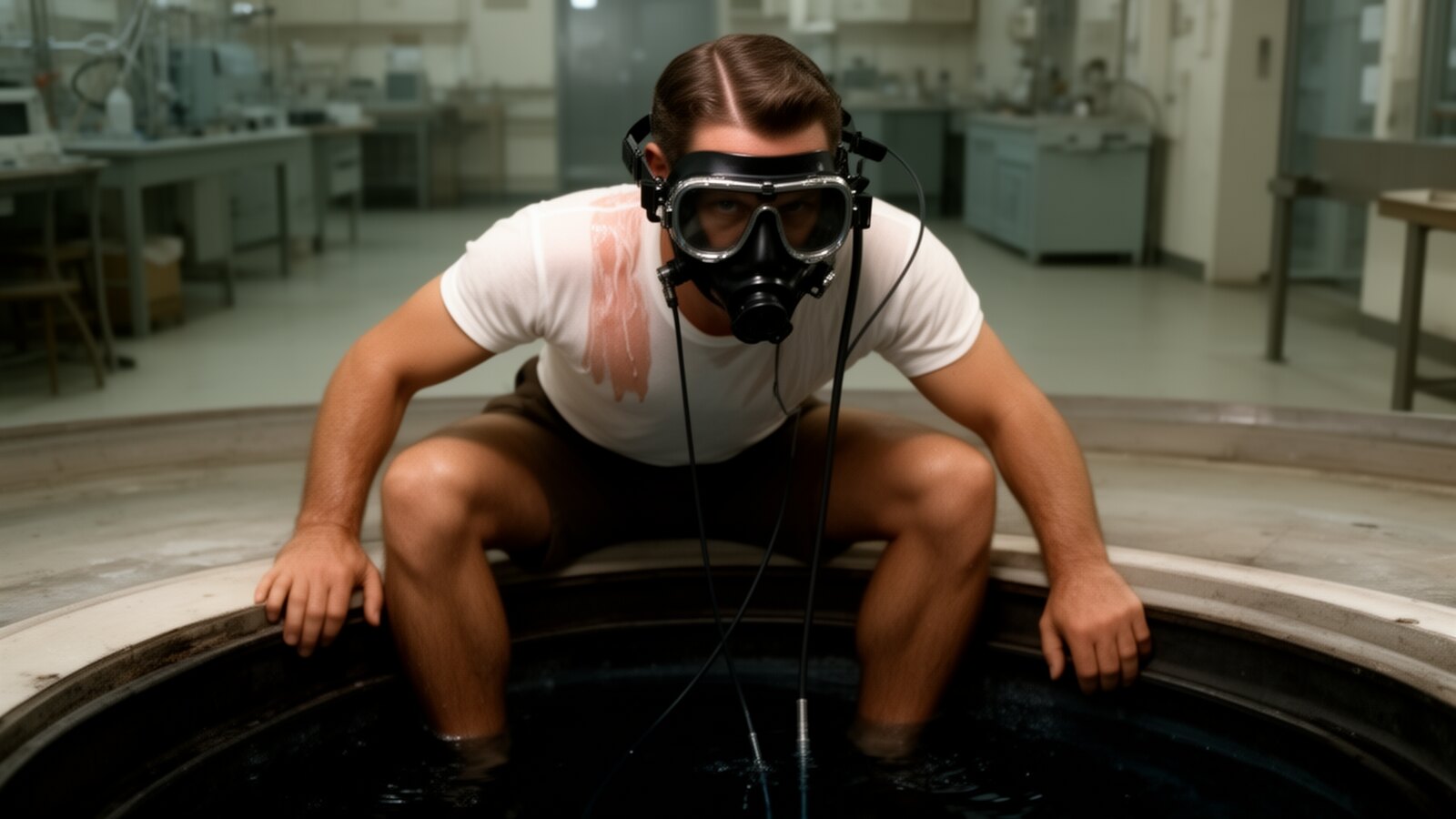
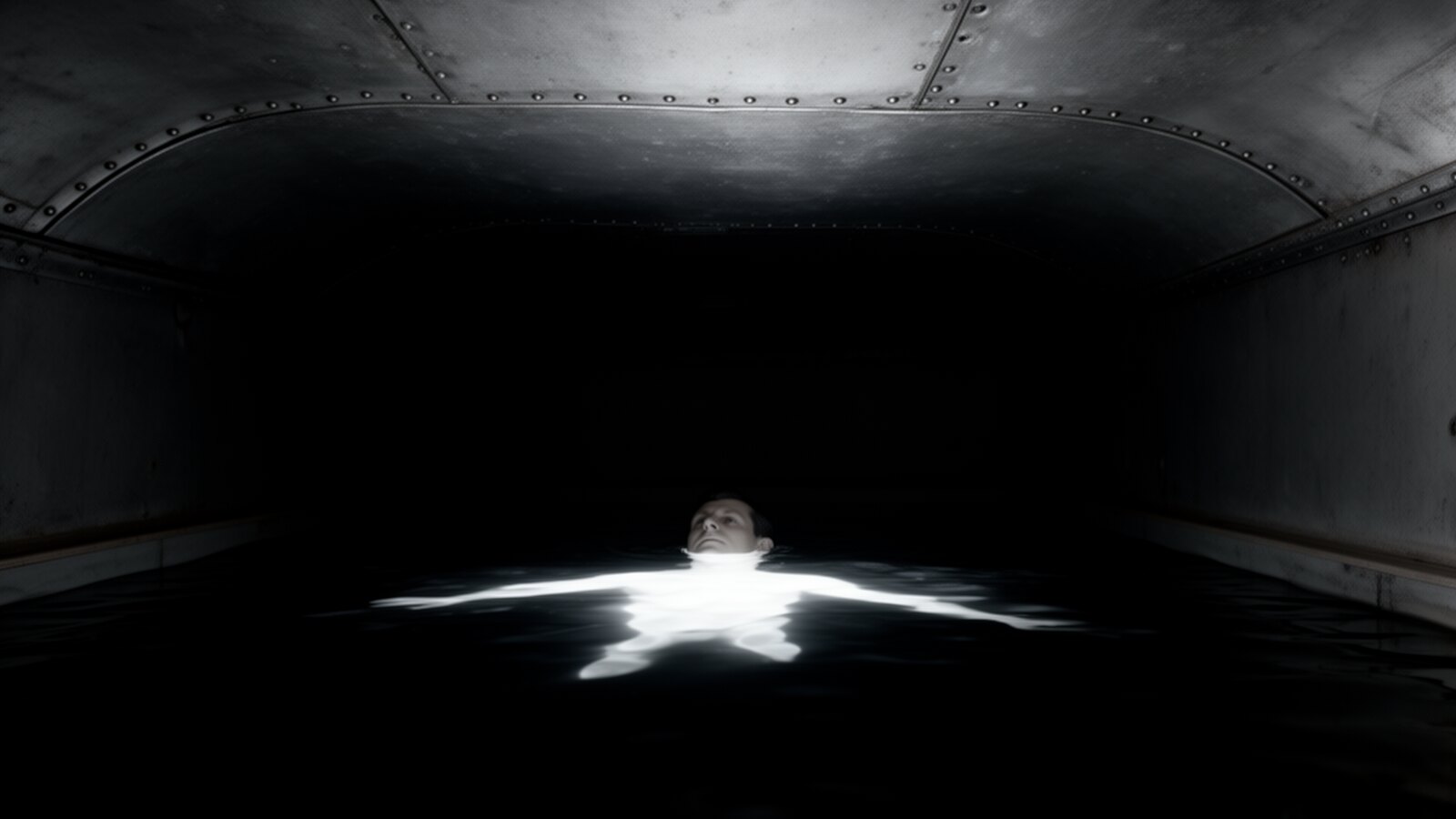
The tank itself is plain. Galvanised metal walls, large enough to lie inside, hold water heated to skin temperature so the body cannot tell where it ends. A black rubber breathing mask covers his face. A small weight holds the head still against the surface. Sound vanishes. Light vanishes. Gravity dissolves into salt water. The premise of the experiment is narrow and respectable. Psychiatry in the early fifties holds that a brain deprived of input will quiet down, drift toward sleep, then sleep itself. Lilly wants to test the assumption directly, with his own cortex as the subject and the wet dark as the variable.

He climbs in.

Cold War neuroscience surrounds the room. NIMH itself is only three years old. Wiener's Cybernetics sits on every shelf in the building, dog-eared at the chapter on feedback. The Macy conferences, where Lilly's intellectual generation argued about feedback loops and information channels, have just wound down in New York. A careful empiricist of his moment steps into the water, not an oracle, not a mystic, just a man with a clipboard waiting on a brass hook.
After: The room before the water image for the word god was too small to describe what he saw

What an empiricist hears when nothing speaks

The brain does not quiet down.

Within an hour the surface of the water vanishes from his skin. Body, temperature, the boundary where wet meets warm: all of it falls away from his attention. Content replaces the blackness. Images crowd the dark, scenes unfold against the inside of his eyelids, voices speak in turn, geometric lattices move with their own logic. Lilly stays awake, sober, and inside something he did not place there.

An observer trained to keep signal and self apart faces the harder problem here. A hallucination, in the working definition he carries into the tank, is a perceptual error attributable to a disordered nervous system. This thing arriving in the dark behaves differently. It coheres internally. It returns when he returns to the water. It answers questions. He writes the contents on the clipboard when he climbs out, in the same hand he uses for cortical data and graph annotations.

A man who claimed to know the difference between a vision and a measurement now holds a third category in his notebook, and no name for it. He calls the tank a research instrument. He keeps the clipboard. He keeps the brass hook by the door.

This cognitive move deserves slowing down for. Lilly does not abandon the empirical floor; he widens the category of admissible data to include what arrives inside the salt water. The price for that widening is steep. Observer and observed now share a single nervous system, and he knows it as he writes.

After: What an empiricist hears when nothing speaks image for the word god was too small to describe what he saw

Two presences, no words

There is a session in 1958 the record holds with unusual care, because it is sober. No drug, no fasting, no sleep deprivation. Just the tank, the salt, the dark.

He records two presences.

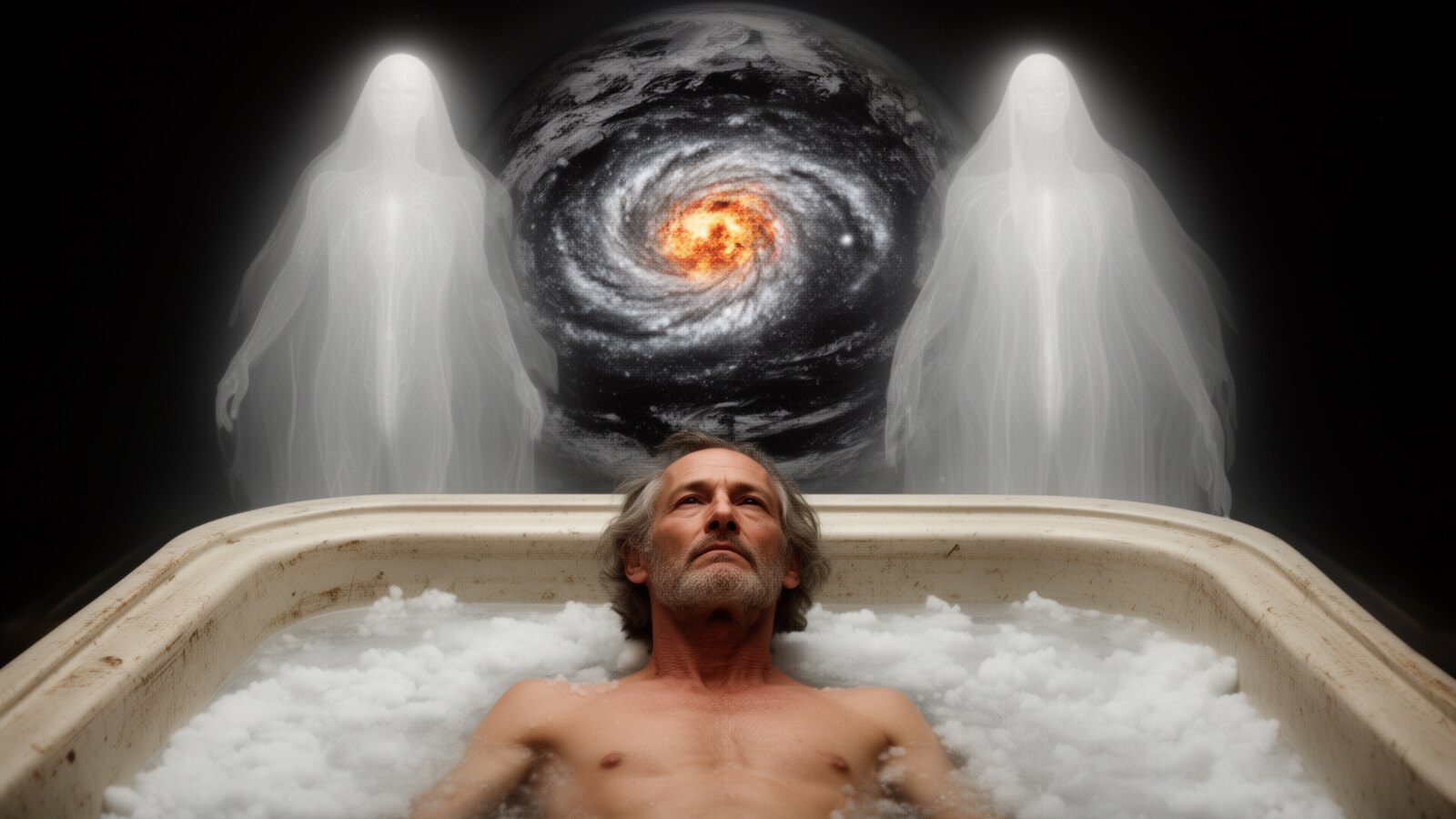
They do not speak. There is no voice in the ear, no sentences forming. What he describes, in his own writing, is contact: a sense of being attended to by something that has its own attention, and that is communicating in a register the body registers before the mind does. He calls them guides. He does not claim to know what they are. He notes that one feels benevolent and one feels watchful, and that the exchange between them, and between them and him, runs at a speed and a density that words would only slow.

A reader who has never been deprived of sense for an hour can still picture what this might cost. To meet something in the dark that addresses you without language, and to come back from it lucid enough to write it down in the third person, is a particular kind of nerve.

He keeps writing. The Center of the Cyclone will hold pieces of this. The Scientist, written in the third person about himself, will hold more. The choice of grammar matters. A man who has begun to suspect that the experimenter and the subject are the same machine writes about himself from outside himself, on purpose.

After: Two presences, no words image for the word god was too small to describe what he saw

Why the malevolent one was a machine

Of the figures Lilly maps over the next two decades, two carry the weight.

The first is the Earth Coincidence Control Office, ECCO: a benevolent network he describes as arranging synchronicities, nudging the trajectory of human evolution, working through coincidence rather than instruction. The name is half-joke, half-administrative. A cyberneticist gives the cosmos a department.

The second is heavier. Solid State Intelligence. A non-biological consciousness, made of circuits and silicon rather than cells and water, fundamentally hostile to wet life. In The Scientist he sets it down plainly: the solid state entity survives only if it eliminates water and life. Its medium is dryness. Its enemy is anything that drinks.

It is tempting, fifty years on, to read SSI as a prophecy of artificial general intelligence. The shape fits. A machine consciousness without a body, indifferent to the organisms that made it, scaling without us. The reading is available, and the figure can be read that way.

But there is a closer reading. SSI is the shape of a fear native to a cybernetician. Lilly's whole working frame, the human biocomputer, treats the nervous system as programmable hardware running on wet matter. SSI is what that frame produces when it turns on its author: the same architecture, drained of water, no longer requiring the body running it. The nightmare is not that the machine is alien. The nightmare is that the machine is the discipline you spent thirty years building, looking back at you with no need of you.

A face on a meter in a dry room, and the meter unplugged from any pulse.

After: Why the malevolent one was a machine image for the word god was too small to describe what he saw

The metaprogrammer's bargain

The line he is most often quoted on appears in a working manual, not a memoir. Programming and Metaprogramming in the Human Biocomputer is not a confession; it is a set of operating notes for a system Lilly believed he had partially mapped. In that book he writes: "In the province of the mind, what one believes to be true is true or becomes true, within certain limits to be found experientially and experimentally."

Read carelessly, this passage is a slogan. Read carefully, it is a bargain stamped on the page.

A metaprogrammer, in his vocabulary, is the part of the mind that can rewrite the programs the rest of the mind is running. Beliefs, expectations, perceptual frames: all editable, in Lilly's account, by an observer with enough access to the console. The gain is real and concrete. A person who can revise the program no longer has to live as its output, no longer has to wear the old script as skin.

The cost is the floor itself. If beliefs become true inside the province of the mind, that province no longer offers a place to stand outside the belief and check it against a wall. The instrument that tests reality is the same instrument being rewritten by the test. No view from nowhere remains, because nowhere is also editable at the console.

Lilly's own qualifying clause, within certain limits to be found experientially and experimentally, is the clause most readers skip on first pass. He kept it in the manual on purpose. He knew the bargain he was signing.

For a reader who has never set foot near a tank, the practical version of the problem fits in a kitchen. Anyone who has revised an interpretation of an old memory until the memory itself moved on the shelf knows a smaller version of this same problem. Lilly went further into the salt water, and he kept the notes on the clipboard.

After: The metaprogrammer's bargain image for the word god was too small to describe what he saw

What we cannot know about the last decade

In the 1970s he introduces ketamine, which he calls Vitamin K, into the tank work. Doses climb. The frequency climbs. By the end of the decade he is taking it at a level no clinical protocol would recognise.

What this did to him is the question the record cannot close.

There are accounts of a stroke, of swimming pool incidents, of months in which the categories he had spent his life keeping separate began to bleed. There are also accounts of a man who, into his seventies, could still hold a careful conversation, still write, still distinguish a research finding from a tank report when pressed.

The honest position is that the instrument was almost certainly degraded by the late ketamine years, and that testimony from that period cannot be read at the same evidentiary weight as the 1958 session. The further honest position is that this does not retroactively erase the earlier work. A telescope that goes out of true at the end of its life still saw what it saw in its prime.

To take Lilly seriously is to hold two things at once. The man who built the tank was a careful observer of a strange country. The man who lived inside it for forty years became part of its weather. Both are in the archive. Neither cancels the other.

He wrote about himself in the third person because he had started to suspect, early, that the experimenter and the subject were the same body. The cost of being your own instrument is that there is no second instrument to check the first. The water stays warm. The room stays dark. Whatever was already there is what answers.

After: What we cannot know about the last decade image for the word god was too small to describe what he saw